
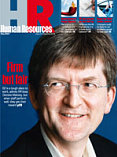
Even senior executives have skills gaps. But to attend conventional training might look like a public admission of their failings. Sally Whittle looks at more subtle ways of presenting them with opportunities to learn.
It goes without saying that telling your boss he doesn't actually know it all is a potential minefield. But if you are responsible for organising training and development in any organisation, it's a necessary task.
'As human beings and professionals, we never stop learning,' points out Anne Scoular, managing director of training company Meyler Campbell. 'And the evidence is that successful people are highly motivated to learn - so your boss could welcome the chance to develop new skills, if you present the opportunity in the right way.'
The 'right way' doesn't mean bluntly telling your managing director that he's useless at figures and needs to go on a four-day residential training course before the company goes under. 'It's important to know who you're dealing with,' cautions Jonathan Perks, managing director of leadership development with consulting group Penna. 'I would say that 70% of executives are traditional alpha males. That means they're competitive, they're driven and they want to get things done.'
Rather than trying to teach your executive team, Perks advises presenting them with opportunities to learn - thereby giving them the illusion that they have chosen to take part in the training scheme. Also, choose any training provider very carefully.
'These guys want to be inspired, they want to learn from peers and people who have credentials, not from some youngster with an MBA,' says Perks. 'A regular training course is just going to make your CEO feel as though he's being sheep-dipped.'
One way to avoid this is to provide a one-to-one development programme, such as executive coaching. This has the advantage of being more flexible than conventional training, and provides executives with an opportunity to focus ruthlessly on themselves and their own problems.
'Sometimes, senior execs won't want to admit difficulties or uncertainty in a public forum, so coaching is a secure way for them to address those problems,' comments Stephen Wigzell, a partner in coaching company Praesta.
Senior executives may prefer coaching because it doesn't require a massive investment of time - coaches and executives usually meet for a couple of hours once a month. For busy HR departments, it also has the advantage of only requiring two diaries to be co-ordinated. 'Trying to get four or five board members to agree to a course on the same day can be a complete nightmare,' says Wigzell.
Another advantage of coaching is that it can help executives develop some of the softer skills that can be lacking at the top of many organisations. 'As managers progress in their careers, emotional skills aren't always so important,' says Perks. 'But at the top of the ladder, I'd say 30% of success is down to what you know, and 70% is being able to persuade people of your vision and get them to buy into it.'
However, coaching alone is unlikely to be enough to keep your executives performing at their peak. 'The point is that even if your chief executive knew it all when he took the job, the world has moved on, and continues to do so,' says Margi Gordon, principal consultant at Roffey Park. 'Leaders also need to cultivate a totally different sort of knowledge to more junior staff. They need to know where they are taking the organisation, and how to persuade people to join them.'
Gordon advises companies to consider giving senior executives hands-on experience of other roles and departments within the company as a good way to build new knowledge and skills quickly. 'Doing something different through a secondment programme allows people to apply knowledge in a different environment, outside the normal structure, but still within the organisation,' says Gordon. 'Overseas assignments can have a significant impact for the same reason.'
If secondments work well, you might consider implementing a formal executive rotation scheme, where employees swap jobs for a period of several weeks or months. 'This kind of thing has been shown to encourage innovative thinking, because people come to problems with a totally fresh perspective,' says Ian Taylor, vice-president of leadership at Forrester Research. 'However, it needs to be a formal process, so you're not just landing the finance department with some idiot from marketing who hasn't a clue what he's doing.'
Most experts agree that coaching and executive rotation are great development tools - but they should be combined with other, more formal training exercises if you want the best results. The challenge for HR directors, however, is finding training that will be sufficiently challenging for very senior staff. 'In reality, most training at this level has to be bespoke, because there aren't general courses relevant to what people at this level are doing,' says Meyer Campbell's Scoular. 'Even if you're looking at softer skills like communication, it's a lot easier to work on those individually or with a small syndicate of executives.'
When considering any training course, you should look for something that is absolutely relevant to the job your executive is doing on a daily basis, says Tom Barry, managing director of consulting group Blessing White. 'This level of executive wants data,' says Barry. 'They're not interested in the process, or gathering background information - they want hard data that they can take back to the office and put into practice.'
Many leadership training courses focus on case studies - where senior executives from other companies talk about an experience they have had, or a problem they have resolved. Barry believes these exercises are increasingly irrelevant to many of his clients. 'They only work if this person has worked in your industry, or has solved a problem you're facing,' he says.
One increasingly popular training option is the simulation exercise. This involves bringing together a small group of very senior business executives, and presenting them with information about a specific situation. Then, the executives are presented with a challenge - and asked to solve it. 'This kind of thing really appeals to their competitive instincts, and if the simulation is good, it will challenge their decision-making processes and their knowledge of things like legislation or business process,' says Barry.
Once an executive has undergone any training programme, it's vital to provide accurate feedback. Since senior executives tend to be results-focused and competitive, they will naturally want to know how they performed, ideally being measured against an independent criteria. 'And don't make the mistake of just telling them the good stuff,' adds Barry. 'One of the hardest things about being the boss is that no one tells you what you're doing wrong.'
Providing effective training at a very senior level might be a constant challenge - but it's one you can't afford to duck. 'Think about the money you invest in training newcomers and junior staff, and then compare it to what you invest in those people whose actions have a much bigger impact on the business,' says Scoular.
HEWLETT-PACKARD - TRAINING FOR THE UPPER ECHELONS REQUIRES SPECIAL TREATMENT
In the fiercely competitive hi-tech sector, training is the only way companies such as Hewlett- Packard (HP) can keep their people ahead of the competition. This means learning and development is a constant priority at all levels of the organisation, according to Ed Marsh, director of learning and development for HP in EMEA.
That said, training at the upper echelons of the organisation is treated differently, says Marsh. 'At this level, it's much more about learning than training,' he says. 'You can't send a VP off on a training course and then consider the job done.'
In particular, Marsh argues that leaders most often need training in the very basic art of being a leader. 'In the case of senior people, they have moved from doing a job to managing people, then managing managers - and now they're managing whole organisations,' he says. 'That involves skills they haven't used before.'
HP has taken a diverse approach to training, believing this offers greater cumulative benefits. Senior executives do attend formal training courses in areas such as Sarbanes-Oxley or other legal issues, but most development is done through other means.
One of the company's newest programmes is a 'leaders teaching leaders' scheme, which invites senior company representatives to lead training programmes for colleagues in areas where they have expertise. 'The thinking behind this programme is first that people often only really internalise knowledge when they are imparting it to someone else,' explains Marsh. 'And second, it also helps to develop people's interpersonal and collaborative skills, by putting them into a teaching role.'
HP has also invested heavily in executive rotation, allowing people to get hands-on experience of other departments and divisions within the company, perhaps also working in different countries. It's this level of practical experience that gives senior executives a real competitive edge, Marsh says. 'I think, at this level, it is a bit like learning to drive a car. Sure you can read a lot of books, but it's not until you're out on the road you know what it's really all about,' he points out.
Finally, executives are regularly invited to share lunch with a small group of colleagues who are at similar levels in other parts of the organisation. At each 90-minute lunch, one executive is invited to present a problem or challenge to his colleagues, who will offer advice and support.
'It's great because they get immediate value from the lunch meetings,' says Marsh. 'They are solving problems, or at least getting the benefit of some great coaching.'
HR Magazine - March 2007
 Download this article in PDF format.

