
Jessica Pryce-Jones (BC05), CEO of the iOpener Institute
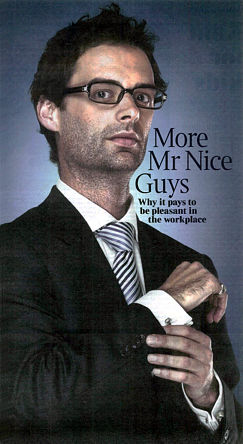
It’s a dog-eat-dog world where only the selfish succeed, right? Wrong, says Jessica Pryce-Jones. If you really want to reach the top, be nice, not nasty.
What do Kate Middleton, Roger Federer, the British Open champion Darren Clarke and Tom Pellereau, winner of The Apprentice, have in common? It’s obvious. They’re nice. In fact, they seem to be gorgeously nice and their charm plays a huge part in how much we like them.
And how about Chris Anderson, the power behind TED (Technology, Education and Design) Conferences? He’s a famously nice man and, as of June, TED’s website had more than 500 million hits. On the flip side, nice isn’t a word you’d easily use about Dominique Strauss-Kahn. And Simon Cowell once declared: “We’re in the music industry: we’re not nice.”
In fiction, film and popular culture, nice is the last word ever associated with bosses. There’s Lord Sugar, with his grouchy you’re fired” persona; Gordon “greed is good” Gekko; and next week brings the opening of the film Horrible Bosses, in which three friends so loathe their bosses that they conspire to murder them.
Portrayals such as this carry the assumption that being nice means getting walked all over or being an unassertive wimp. But that is not the case. People who are nice, such as Pellereau, treat others with respect, listen to them, are accountable for what they do, are courteous, deliver, apologise when necessary, are cheerful, authentic, dedicated, warm and a general pleasure to be around. They are the antithesis of the monsters in Horrible Bosses.
Particularly in the business world, being nice is vastly underrated. Yet nice sets you head and shoulders above others. Here is how Dr Stephan Chambers, of the Saïd Business School, University of Oxford, defines it: “It’s who we’d like to be with, who we’d like to be esteemed by, who we’d like to work with and for, and how we’d like to be.”
And it particularly matters now.
That’s because when times are enduringly tough, when our banks fail, our jobs disappear and our newspapers close, the relationships we have with the world – and how we think about it – change. If we can’t trust core elements of a system, the only option we have is to build trust with individuals instead. That’s when relationships start to matter so much more. Relationships are the one thing you can work on to make better, because you can protect, grow and invest in them if you choose to. Our relationships give us the stability that institutions, regulation and cash can’t.
And our relationships are fundamental to the opportunities we get. In 1973 the social scientist Mark Granovetter found that 56 per cent of people finding new jobs got them through their networks. Most importantly, of those people who found jobs, 83 per cent found those jobs through “weak ties” – in other words, from friends of friends, or contacts they rarely saw.
Granovetter’s study was replicated 20 years later by the researchers Deborah Brown and Alison Konrad. Today, many organisations are holding back on advertising new jobs: relying on networks is much cheaper. This means that your contacts – the people who’ll recommend you – are ever more important.
So what does it take to get recommended? No surprise, it’s your reputation: and the key ingredient is being nice. You’ll only have a decent network if people like you, and they like you because you’re nice.
Think about it the other way round: you’ll never open a door for someone you actively dislike. Nasty leads only to dead ends. Which is why people who are nice are starting to reap such large dividends.
But this isn’t new news.
There is a lot of research which shows that nice has always succeeded over nasty. Common sense tells us that. After all, how many nasty friends do you have?
We first understood the power of being nice at work in the Eighties, when Dean Tjosvold, Professor of Management at Lingnan University, Hong Kong, carried out studies which showed that nice leaders got more out of people than nasty ones. Now we can calculate the cost of poor leaders who exercise power through fear or bullying. First, because they lose team members; second, because their employees spend a lot more time and effort covering their backs rather than getting on with their jobs; and third, because their negative emotion spreads within a social network. That network invariably includes clients and customers.
Our research at the iOpener Institute for People and Performance estimated that the cost of this misery adds up to about £3,378,000 per 1,000 employees in terms of sick leave, employee turnover and the reduced time that staff focus on their work. On top of that, it also results in employees looking to get even – to rebalance their psychological contract.
1 know this because I used to work for a jerk. He was a French boss who loved formality, favouritism and power play. He didn’t believe in team meetings for fear we’d learn too much. Instead, he would give us all different snippets of information. Then he’d sit back and enjoy the fireworks.
One day he bought an Apple Mac that was difficult to synchronise with our network. Waving a service agreement at our IT support, he got a team of five people to toil over the weekend to make his laptop work. It was no surprise when six months later, with our systems down, we had to pay treble what we should have done to get the show back on the road.
Tiziana Casciaro, of the Rotman School of Management in Toronto, published a revealing article in Harvard Business Review about the “power of nice” in 2005. She and her colleague Miguel Sousa Lobo showed we all want to work with people who are highly competent and very likeable. But when they are not around, we would rather work with colleagues who are nice over colleagues who know their stuff. Her subsequent research clearly shows that we will keep making an effort for nice colleagues in a way that we won’t for people we actively dislike.
Our research, based on data collected from 8,000 people over six years, also shows how important likeability is. In fact, it’s a key element for high performance and happiness at work. When it comes to getting a contract, a promotion or simply being noticed, we like those who share our values, help us, build mutual respect, achieve important goals together and push us to be the best we can. And we like them when they are nice to us.
But nice people can be tough, too. Being nice doesn’t mean failing to set direction or letting people off the hook. As Paul Boissier, a former submarine commander and CEO of the RNLI, told me, “even when things are difficult and you have to deliver change, you don’t need to do it in a heartless, authoritarian style.
“The ‘nasty’ boss is, in my experience, someone with too much ego, too little self-confidence or too little ability. A nice person isn’t threatened by the people who work for him or her, no mailer how able they arc: rather they benefit from the skills, ability and passion of everyone around them.”
That gives you a strong clue to what being nice entails. Nice goes hand-in-hand with a certain level of humility and a lot of recognition. For example, I recently went to interview Adam Parr, CEO of Williams Fl. While waiting for him, I sat in the sunlit hail at the company’s headquarters in rural Oxfordshire. Bang in the middle of the hail was the car that Nigel Mansell had driven to victory in the 1992 World Championship, surrounded by five admiring men. Nearby was an employee cleaning the floor. As Parr walked towards me he stopped and said to her: ‘Thank you, Liz, for keeping the floor so clean”. She looked at him and gave him a big smile. My first thought was, “what a bloody nice bloke”, and my second thought was, “he’d be OK to work for”. That’s the power of nice.
If you want to know what nice really looks like, watch out for this: a boss, a colleague or a friend who isn’t too grand to muck in when the chips are down and who will be your best cheerleader even as they lend you a hand. Who will tell it to you as it is, who won’t let you down, who give you kudos when you deserve it and gets in touch just because.
Women are very good at nice but until now we haven’t been rewarded for the real hard and measurable value that it brings.

I’ll close with what Bill Liao, the internet entrepreneur and co-founder of Xing and WeForest, said: “All the best people aren’t just nice: they’re wonderful.”
Jessica Pryce-Jones is CEO of the iOpener Institute for People and Performance and author of Happiness at Work: Maximising Your Psychological Capital For Success.
Sir Richard Lambert, Director-General of the Confederation of British Industry (CBI) from 2006-2011
“There are plenty of nice guys around who are running companies very successfully. Ken McMeikan, CEO of Greggs the bakers, is a very sweet bloke and has all sorts of good initiatives like breakfast clubs at primary schools.
“Helen Alexander, president of the CBI, is very businesslike in the way that she conducts meetings but is also a decent and kind person, and really remembers things about people.
“If anybody behaved in real life like Lord Sugar does on The Apprentice, they would quickly find themselves all alone in life. It’s all good entertainment and he is brilliant at it, but it isn’t real. If any of the contestants behaved that ruthlessly in real life, you wouldn’t put up with it.
“Business in developed economies like ours needs increasingly brainy and motivated people. You don’t get that by bullying, as the talent would clear off. We are in an economy where value is added by brains more than brawn.
“As boss of a large company, you have to make decisions that are going to have tough consequences on people’s lives, but you also have to make clear that you have all the time in the world to talk to people. It is jolly important to walk around and chat to people and keep your door open or, ideally, not have a door at all. Be straight with people, as really nasty people get their comeuppance in the end.”
Derek Sivers, entrepreneur and founder of CD Baby
“When I was a junior in college I had a professor who asked me to speak to his class. I saw him eating lunch and I wanted to ask him something. I approached him in a humble and polite way and he started spitting and swearing: I thought ‘whatever’. But 25 years later I still remember what an ass he was. It would have taken the same amount of time to say ‘see you in 30 minutes’ but he couldn’t control himself I wouldn’t help him if he came to me today.
“Everyone should remember that the people you meet on the way up you’ll meet on the way down. It takes no extra time to be nice but it means everything, and it makes all the difference in the world.
“When I say that being nice makes all the difference in the world, I don’t mean you’ll sleep better at night. I mean it makes all the difference in the world because your career is decided by other people: your investors, your customers, your vendors and your employees. Being nice always works in your favour.”
Kaya Burgess
The Times – July 2011
 Download this article in PDF format.

